Parents – Here is just another reason why you NEED to know what is on your child’s phone. The newest, hottest social media app is Snapchat. It’s an app that allows users to take a picture, add some text if they want, and send it off. When the recipient receives it, the picture deletes itself up to 10 seconds after it has been seen.
For those of you I know personally – Some of your children are using this app. I added this app to my phone and it tells you what contacts in your phone are using this app. Some of your children’s names popped up. I am no going to divulge who those young people are. That is something you need to investigate and talk with your children about. (By the way, the same holds true for Instagram – Your children are using this app too.) Facebook is full of requests from our young people to “Snapchat me”.
What is this picture, taken from Snapchat’s website implying?
My first thought after hearing about this app was “Well, that’s stupid. Why would that appeal to anyone?” That thought lasted about as long as a person can view a Snapchat picture sent to them. My next thought was this app is just begging for people to send nude photos of themselves. I’m sure the Snapchat user’s thought process goes like this: “What could be more perfect? Take a naked picture of myself, send it to ___________ (fill in the blank of the person to be impressed by said picture), he/she will be impressed and like me. Life will be great because photo will automatically deleted and I will be considered cool because I’m giving him/her what he/she wants. This is awesome!”
Ad for Snapchat from a college website
This thought process couldn’t be more wrong, and this is why we need to stay vigilant as parents in keeping up on what our kids are doing. We MUST keep reminding them that what they do online will be there forever no matter what they read or hear.
Snap chat arms immature minors (there are no age restrictions) with an easy way to send photos of themselves and others that could have long lasting consequences past the 1 to 10 second timer on the app.
Although an interview with Snap Chat’s CEO, explains that sexting is not the motivation of the app the FAQs say something completely different:
According to Snapchat’s 22-year-old co-founder and CEO, Evan Spiegel, “it doesn’t actually make sense for sexting. Because you see the photo for, what, three seconds?”
Snapchat photos don’t last very long.
From Snapchat’s FAQs:
IS THERE ANY WAY TO VIEW AN IMAGE AFTER THE TIME HAS EXPIRED? No, snaps disappear after the timer runs out. You can save snaps that you capture by pressing the save button on the preview screen.
WHAT IF I TAKE A SCREENSHOT? Screenshots can be captured if you’re quick. The sender will be notified immediately.
Yes, anyone can take a screen shot if they are quick enough, and as we can see by watching our kids text, they can be very nimble with their fingers. Even though the sender is notified if a screen shot is taken, it doesn’t matter. The damage is done. A digital photo can be taken of the phone when a Snapchat image is received. Then, the sender doesn’t even know that the image was captured.
Those pictures could be sent around faster than you can imagine, ruining a young persons reputation in a matter of minutes.
Snapchat’s main feature is definitely implying a false sense of security. Their privacy policy states that they “cannot guarantee that the message data will be deleted in every case” and “Messages, therefore are sent at the risk of the user”. So, theoretically, if a child were to send an inappropriate photo through Snapchat, the image could be floating around on their servers even after the photo has been deleted from the recipient’s phone. How do we know that we can trust Snapchat employees to respect their users’ privacy? The answer is: We can’t. And the consequences can be disturbing, with parasite porn sites stealing and spreading images and videos of young people, and tragic tales of victims like Amanda Todd, who was bullied so badly over images of her that were shared over the net that she commited suicide. (Taken from Nakedsecurity.sophos.com)
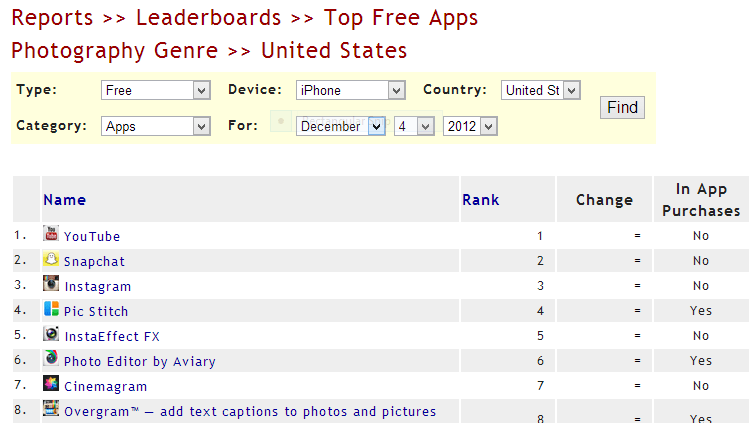
As you can see from Appdata.com, as of today, Snapchat ranks 2nd in photo sharing apps.
Snap chat is currently sharing more than 10 million images a day.
Parents, as you can imagine, Snapchat would allow a child or teen to send nude photos to their friends without fear of becoming the laughing stock of the school or ending up on a porn site, but we should expect more from our children. We should expect them to make good decisions for themselves, regardless of how easy technology makes it from them to do otherwise. My hope is that you will take this knowledge and use it to leverage your vigilance at home. Keep an eye out for this app on your child’s mobile device. If you see that they’ve downloaded it, chances are it’s time to sit down and have a serious conversation about the consequences of sexting.
I found this video on Facebook. It is so moving to me for some reason.
I’m pretty sure these people were intentional with the contrasting message of the consumerist aspect of being at the mall (focusing on spending money to purchase gifts that will eventually find their way to being stored in the basement, going out of style, or being replaced by the new upgraded version, etc.) to proclaiming the birth of the newborn King, our Savior, Jesus Christ (focusing on the One who was born in a lowly, crude stable. The One who will never be put into storage in my basement, and hopefully, not yours either. The One who will never go out of style. The One who doesn’t need an upgrade; He was already upgraded once on the cross for our eternal salvation, and doesn’t need any more upgrades).
Here’s the great news – There’s no cost for our salvation. We don’t need to go to the mall to buy it. The price was paid when Jesus went to the cross. He gets what we deserve, and we get what He deserves. It is a gift given freely from God. There is nothing we need to do to have it. In fact, He wants to give us this gift so badly that he chases us to give it to us. We just need to let him catch us.
Please experience the joy that this video gives in heralding the birth of Christ, at the mall, to those who don’t know Him. It’s probably not unlike when the angel announced that the Savior had been born in the town of David. Then a host of heavenly beings appeared with the angels and began singing praises to God. When the singing was over, the shepherds decided to travel to Bethlehem and see the Christ-child. (Luke 2:1-20)
I don’t know for sure, but I bet there were some “shepherds” there who decided to find out some more about Jesus that day.
Feel free to experience the joy of this bringing tears to your eyes as people are moved to fall on their knees in worship. Maybe they didn’t even know why they fell to their knees. That my friends is the Holy Spirit in action.
***Please note that this article only talks of instagram in terms of Ipod and Iphone. It is an Android product as well, and now profiles and comments can be viewed on the web***
In many ways, and without reinventing the wheel, Instagram is changing the way people share photos with each other. The mobile app, which is only available on the iPhone, is steadily growing in popularity among the kid and teen crowds, causing parents to take notice and ask, what exactly is Instagram, and is there anything I should be worried about?
Just like with any social sharing application, there are a few things parents need to know about Instagram and how their teen may be using it, so the Yoursphere for Parents editorial team did the research. But first, what is Instagram?
What Is Instagram?
Instagram is a photo sharing mobile app that’s (currently) only available on the iPhone and iPod Touch. Users can either upload a photo from their device’s library or take a photo right then and there and use Instagram to change the way the photo looks.
The user then has the option to simultaneously upload this photo to a number of social networks, including Facebook, Twitter, Flickr and Foursquare, depending on which ones they sync to their Instagram account. The photo will also be uploaded to the Instagram community where people can like and comment on it.
In many ways, Instagram is a photo-sharing social network on its own. Users have a profile with the option to fill out information such as first and last name, username, birthday, gender, bio, email address and phone number. Popular photos from all over the world are shared under the “Popular” tab, and every user has the option to follow other Instagram users and vice versa.
The idea behind Instagram is simple, really. And they execute it so beautifully. But just like with any social sharing application, there are some privacy and concerning content issues that can ruin the Instagram experience for a family with kids and younger teens.
What Parents Need To Know
Privacy
The only information required when signing up for Instagram is an email address and desired username. Though they ask for a phone number, it’s very clear during sign up that this is optional, so please consider your privacy or your teen’s privacy before entering a phone number here.
The single most important thing to realize is that, by default, anyone can view the photos that you upload to Instagram. In other words, your profile and your photos are publicly viewable unless you tell it otherwise. If you only want your followers to see your photos, then you need to set your profile to private by following these steps:
Go to your profile page (tap the Profile tab)
Scroll down to the bottom of the Profile page, where you’ll see a “Photos are private” switch
Toggle the “Photos are private” switch to ON to turn on privacy.
Once you set your profile to private, anyone who wants to see your photos will need to be your friend/follower first, meaning they’ll have to send a request and you’ll have to approve.
Geotagging
During the process of uploading a photo, the geo-location data of the photo you’re uploading can
easily be shared with your followers if you’re not careful. Fortunately, Instagram turns geotagging off by default, but it’s easy to accidently turn it on.
When uploading a photo, be sure to avoid tapping the button shown in this screenshot. If you do, you can always tap it again to turn it off. This is just something to be aware of as geotagging is a huge risk to you and your teen’s privacy online. You can learn more about how geotagging works,here.
Age-Appropriateness
Instagram is not for children under the age of 13, and in my opinion, not suitable for slightly older teens, either. If you’re 12 years old, there isn’t even a 1999 year to choose when signing up. Instagram has strict Terms of Useand Community Guidelines that make their age requirement clear. Also, there’s an obvious connection between Instagram and other adult-intended social networks like Facebook and Twitter.
Blocking and Reporting Users and Content
While there are tools for reporting/blocking users and inappropriate content, know that people will, and do upload nude photos. In fact, the editorial team found a multitude of bestiality photos in less than one minute when searching for friends. It’s a sad fact, and another commonsense reason that you shouldn’t allow your children to use Instagram. If you are an Instagram user, they provide easy-to-use tools to block or report someone. The steps below show you how:
Blocking a user –
Navigate to their profile page (tap Profile > Search Instagram > Names and usernames, then search for and tap on their username).
Tap the button in the top right corner of the screen (gear icon).
Tap “Block user” to prevent the user from viewing your account.
The same steps can be followed to report a user, in addition to giving a reason why you’re reporting them.
Reporting a photo –
Tap the “…” below the photo you would like to report and then “Flag for review”
Select the proper reason for reporting from the list and, if prompted, a short description.
NOTE: All flags are anonymous and go directly to Instagram.
—————————————————————————————————
So, parents, do you use Instagram? Does your teen? If so, have you or they encountered any privacy, bullying or content issues like we did? As I said at the outset, Instagram does a simple and fantastic job of letting us do some very fun and creative things with our photos. Frankly, in my opinion, it’s a shame that others ruin what should be enjoyed by you and your family.
Please share your thoughts in the comments below. And remember, there are plenty of apps out there, just like there are plenty of social networks out there that were made FOR your children, and with their privacy in mind. And though it’s a wonderful app that enhances the way we share photos, Instagram is not one of them.
I hope you have found this series useful. I can’t stress enough how important it is to know what your kids are doing when online. It’s important to understand that online doesn’t mean sitting in front of a computer. If they have a smart phone, they can be online anywhere. For their safety, please know what they are doing.
Business news today is dominated by Instagram, a quirky photo sharing application. Facebook has announced it’s buying the start-up used by 30 million people in a deal worth about a billion dollars in cash and shares.
Some of the most prolific users of Instagram are teens. Using their iPads and smart phones, they snap photos, embellish them and share them with friends.
Instagram is a hit with teens. (Karly Domb Sadof – AP)
A 16-year-old writing for the teen-produced site Radical Parenting detailed in a recent post why she and her friends are addicted to Instagram. Perhaps the biggest reason the application is such a hit with teens, as the writer mentions, is that it offers an outlet for that abundant need teens have for self-expression.
The purchase by Facebook is likely to make Instagram that much more popular. So, it might be a good time for a parental primer.
The folks at Yoursphere For Parents, a group that provides Internet safety information, recently gathered some helpful tips to better supervise this digital playground.
First, it’s important to know that photos uploaded on Instagram can, by default, be viewed by anyone, anywhere. There’s also an option to share the photo location, which may be of concern if a parent would rather not have a child broadcast his whereabouts.
Also, Instagram, like Facebook, is not supposed to be used by children under 13. Images are usually cute or artistic, but there are also nude photos and disturbing images to be found.
The application requires an account sign-on, which includes entering a birth date, but many parents have already found that tech-savvy kids easily overcome this obstacle.
Also, like so many digital gathering places, Instagram has been used for cyber-bullying.
The Yourshpere editors make it clear that it’s not the application itself that is necessarily a problem — and the Radical Parenting writer offers a glimpse at how teens are using it to explore their artistry.
Still, a certain level of supervision is advised.
Do your kids use Instagram? How? Do you monitor their use?
Ok. I’ll admit it. I’m getting fairly addicted to Instagram. I like because it’s fun to take pictures with my phone, add some cool effects and save them to use for my own albums or something in youth ministry. I quickly found out that that it’s a very popular social networking site owned by Facebook. I started being followed by people and in turn I follow people. You can see comments people make on your photos and you can make comments on other peoples photos. It’s starting to become the Facebook alternative for kids who don’t have (or can’t get) Facebook. It does have a 13 year old age limit, meaning you have to be at least 13 or older to sign up, but it’s easy to circumvent that. Instagram is something maybe parents don’t know a lot about and think it’s fairly harmless and let their kids sign up for it. It’s up to you as a parent to decide how harmless it is for your child, but know that “not so good” pictures and comments are not difficult to stumble upon…
That is why I am offering this 3 part series on Instagram. I have found some articles I would like to share with you to give you some information regarding this extremely popular social networking entity. What you do with it is up to you, but it’s no different than any other online access we give to our children – It should be closely monitored.
***By the way – This article speaks of Instagram in terms of Ipods and Iphones. Instagram is also on Android, and has most recently allowed user profiles to be viewed on the web – Pictures and comments. Click the image of my Instagram home screen to see what I’m talking about.***
How Instagram became the social network for tweens
Well-intentioned parents who’ve kept their tweens off Facebook are catching on to the workaround: kids are turning to Instagram, the photo-sharing app that may as well be a social network.
I just learned that my 12-year-old daughter is an app scofflaw. So, in fact, are the hordes of her fellow tween-agers — kept off Facebook by their well-intended parents — who have turned to Instagram as a seemingly innocuous social-network workaround.
As it turns out, just like Facebook, you technically have to be 13 to have an Instagram account. And, just like Facebook, Instagram is more or less a social network, dark sides included. Kids post photos, their followers comment… and then those not invited to said birthday party or shopping excursion get hurt feelings.
Many of us adults discovered Instagram as a nifty photo-sharing app that’s lets you spruce up your photos with cool filters. But it has all the functionality of a social network, which Instagram founder Kevin Systrom says was by design.
“We are delighted that there is such a social component to using the app,” he said, “but we target and intend for our user base to be 13 or older and because of legal restrictions cannot have anyone under that age using the app.”
It’s not easy proving the popularity of Instagram among the tween set with hard data, mostly because, as Systrom acknowledged, the service doesn’t “currently disclose demographic data.” It’s unclear whether this might change now that Facebook has officially closed its purchase of Instagram.
Asked specifically if he’s heard about the growing numbers of tweens on Instagram and Systrom could only offer that the service has grown in just about every demographic, from “the elderly side” to the 13-plus group. “The proliferation of iPod Touches and iPads has also helped growth outside of people that own iPhones,” he said.
But even if Instagram did release demographic data, it likely wouldn’t reflect reality. Users like my daughter and her 100 young followers have managed to get around the strict Instagram terms requiring users to be 13 or older to use the service. If their iTunes accounts are set up correctly, tweens shouldn’t be allowed to download the app, Systrom said. My daughter’s account, for example, must still be tied to my account — she’s had an iPod Touch for years and still goes through me before buying apps. (So yes, I’m actually just as much the app scofflaw.)
Plus, upon signup, Instagram gives you a birthday picker that doesn’t let you chose an age younger than 13, Systrom explained. (My daughter claims no memory of this part of the Instagram sign-up process, so it’s unclear how she bypassed it.) Systrom kindly offered to close my daughter’s Instagram account, as the service does with any account it learns is in violation of terms. But would mean the end of my already shaky cool-mom status, and after all, she didn’t sign on to be the daughter of a journalist.
Hard data My daughter’s experience aside, a few studies help us connect the dots in support of this meteoric rise in Instagram’s popularity among tweens. According to Nielsen, for example, Instagram is the top photography site among teens ages 12 to 17, with 1 million teens visiting the site during July. Nielsen doesn’t categorize Instagram as a social network. While Flickr was top photo site for the overall population in July, Instagram was the favorite among teens, Nielsen found.
Add to that an earlier Nielsen study on growing popularity of Facebook and social networks in general among teenagers, and yet another on how teens tripled their mobile data consumption between December 2010 and December 2011, and the picture becomes clear.
Also, a Pew report presented over the summer about teenage online behavior found that 45 percent of online 12-year-olds use social-network sites and that the number doubles to 82 percent for 13-year-old Internet users. The most popular activity for teens on social networks is posting photos and videos, the study found
Parents caught off-guard We parents have been advised over and over again by educators that our tween-age kids are just too young for Facebook. Most are just not mature enough to gauge what’s appropriate for posting and to know how to respond to cyberbullying or contacts from strangers or spammers.
But with Instagram our guards were down. We never really imagined how it would be used. When my daughter asked permission to download the app, I was frankly excited that she was showing interest in photography. I love using the app and was unaware of the age restriction.
I had heard stories of kids on Instagram who had lost friends over not being included in activities posted to the site. But I only really caught onto Instagram’s ubiquity as a tweenage social network the day before school started this year, when my daughter’s middle school sent out class schedules to individual families using its password protected Web site. Within an hour of viewing the class schedule, my daughter had scribbled out a chart of who was in each of her classes. When I asked how she had figured it all out, she responded, “Everybody posted their schedules on Instagram.”
That started me looking through her account. In another Facebook-like status update, she posted a photo of a note she wrote on her iPod Touch that read, “So glad it’s a 3 day weekend!!!” That got 31 likes.
“My fifth-grade daughter and friends purchased the Instagram app with iTunes gift cards. Her friends thought it was an app to take and share pics and at first didn’t realize they could post comments,” posted a commenter named SAM. “I had no idea that it was a pseudo-Facebook app. (We are waiting until she is 13 to get a FB account.) I did not know that this app would have her following and being followed by hundreds of people she didn’t know…and posting comments…it was alarming.”
Another commenter, Laura, says she’ll be closing her 12-year-old daughter’s Instagram account, which has turned into a “nightmare.”
“She is not allowed to have a Facebook account until high school to avoid bullying issues, but due to my lack of knowledge (I thought Instagram was basically a glorified camera), I allowed her to have an account,” Laura wrote. “In the last week, she has been indirectly contacted by what appears to be a predatorial pedophile posing as a radio contest to which girls send their photos. And she also experienced the middle school drama that I was trying to avoid by the lack of a Facebook account.”
Tweens, of course, are merely following the leads of teenagers, and, for that matter, the general population. An Experian Hitwise survey just found that Instagram increased its market share in the U.S. by 17,319 percent between July 2011 and July 2012.
But a friend of mine just offered up a theory on Instagram’s youth popularity based on the behavior of his 14-year-old daughter and her friends who are also crazy for Instagram. She’s been on Facebook since she was 12 and her parents have always warned her that with other parents (and grandparents) on the social network, she needed to keep her act very clean.
However, her grandparents haven’t yet caught wind of Instagram, so she and her friends can be a little freer with what they post and comment on there.
Of course, it may just be a matter of time before older folks join the party. As Instagram founder Systrom noted, the service’s numbers are growing on “the elderly side” as well.
It happened in Lisle. I don’t if this guy was a normal dad or a little on the crazy side, but it makes me think about the pressure we put on our kids regarding extra-curricular activities. I really notice it around here (Huntley area) with football and softball. For some it think it rules parents lives. There are parents who tailgate (yes, beer bongs were present) at pee-wee football games. The coach had to tell them to stop it.
I understand sports, and other “out of school” activities are important. When it starts to take over our kids, and our lives, it becomes a problem. We, as parents, really need to take a step back and look at our behaviors, attitudes, and values. We need to look at what is really important and make sure our kids are well-rounded individuals so they can be prepared for adulthood. Yes, sports are important, but so is education, social skills, community involvement, spiritual development…the list goes on. Let’s make an effort to raise our children to be well prepared to move into adulthood.
Time to step off of my soapbox. Here is the article:
By Josh Stockinger – Daily Herald
After his daughter was benched at a regional match, a Lisle man threatened to kill a high school volleyball coach and rape the man’s family members, prosecutors said Monday.
John Kasik, 61, also is accused of battering Lisle High School Athletic Director Dan Dillard during a confrontation at school offices.
Police arrested Kasik at his home on the 4400 block of Arbor View Drive on Friday. He was charged with felony telephone harassment and misdemeanor counts of battery and disorderly conduct.
Authorities said Kasik’s temper flared after his daughter was pulled from a volleyball match that her team lost on Thursday. Afterward, he followed Dillard’s vehicle, pulled up next to him and began shouting about the game, said DuPage County State’s Attorney Bob Berlin.
Dillard invited Kasik to discuss the issue at school the following day. But Kasik went home and left numerous text messages and voice mails threatening Varsity Volleyball Coach Matt Hrubesky, Berlin said. The messages continued for about five hours, from 9:30 p.m. to 2:30 a.m., according to police.
“He left voice-mail messages telling the coach he’s going to rape his wife and daughter and kill him,” Berlin said.
Kasik arrived at the high school the following morning for a meeting that quickly turned hostile, according to the charges. At one point, Berlin said, Dillard tried to end the discussion but Kasik blocked the athletic director’s path out of the office and “bumped” him repeatedly.
Kasik posted a $30,000 cash bond Monday and was released from police custody. He could not immediately be reached for comment.
Dillard declined to comment, and Lisle Unit District 202 Superintendent Keith Filipiak and Lisle High School Principal Pete Sullivan did not respond to messages. Hrubesky could not be reached.
Kasik could face up to three years in prison if convicted of felony harassment. Berlin said the case was charged as a felony rather than a misdemeanor because it involved a death threat.
“It’s unfortunate when parents react this way and take their frustrations out on school personnel,” he said. “We will protect these people so they can do their jobs and not have to worry about these kinds of threats.”
Kasik has no prior criminal history in DuPage, according to court records. He is scheduled to appear Nov. 19 before Judge John Kinsella.
Witnesses described the 17-year-old boy as “shaking, growling, foaming at the mouth.”According to police reports, Elijah Stai was at a McDonald’s with his friend when he began to feel ill. Soon after, he “started to smash his head against the ground” and began acting “possessed,” according to a witness. Two hours later, he had stopped breathing.
The Grand Forks, North Dakota teenager’s fatal overdose has been blamed on a drug called 2C-I. The night before Stai’s overdose, another area teen, Christian Bjerk, 18, was found face down on a sidewalk. His death was also linked to the drug.
2C-I–known by its eerie street name “Smiles”–has become a serious problem in the Grand Forks area, according to local police. Overdoses of the drug have also be reported in Indiana and Minnesota. But if the internet is any indication, Smiles is on the rise all over the country.
“At the moment I am completely and fully submerged, if you can’t tell by my eyes, in a psychedelic world known as 2C-I,” one young man with a scruffy chin beard and dilated pupils effuses on a video posted in October of 2011. He’s one of dozens of users providing Youtube “reports” of their experiences on the synthetic drug.
Smile’s effects have been called a combination of MDMA and LSD, only far more potent. Users have reported a speedy charge along with intense visual and aural hallucinations that can last anywhere from hours to days.
“At first I’d think something was extremely beautiful and then it look really strange,” another user says in a recorded online account.”I looked at my girlfriend’s face for a minute and it was pitch black…the black started dripping out of her eye.”
Because the drug is relatively new-it first surfaced around 2003 in European party scenes and only recently made its way to the states- the most readily accessible information about 2C-I comes from user accounts, many of which detail frightening experiences.
On an internet forum one user describes the high as a “roller coaster ride through hell,” while another warns “do not drive on this drug,” after recounting his own failed attempt on the roadway.
Over the past few years, synthetic drugs like K-2, Spice and Bath Salts, have become increasing popular with teenagers and young adults because of their accessibility. Their ingredients are relatively easy to obtain and order online and until recently, they weren’t classified as illegal substances. But as they come under legal scrutiny, one by one, they’ve triggered a domino effect of newer, altered, and more potent versions.
“I think [the drugs] just keep changing to try to circumvent the law,” Lindsay Wold, a detective with the Grand Forks police department, told Yahoo Shine. “Anytime we try to figure something out, it changes.” Since July, her department has launched an awareness campaign in an effort to crack down on the Smile’s growing popularity with teens and young adults in the area. While reports of overdoses have spiked, Wold says it’s difficult to measure it’s growth in numbers.
“The unfortunate thing is if kids who are overdosing on 2C-I go in to the hospital with a physical problem, a lot of times they can’t test for it so it doesn’t show up as a drug overdose,” she says.
The fact that 2C-I is untraceable in tests makes it more of a challenge for doctors to treat. It also contributes to drug’s growing popularity among high school and college-age kids.
“Synthetic drugs don’t generally show up on drug tests and that’s made it popular with young adults, as well as people entering the military, college athletes, or anyone who gets tested for drugs,” Barbara Carreno, a spokesperson for the Drug Enforcement Agency, tells Shine.
2C-I may be undetected in drug tests, but it’s effects are evident in emergency rooms.
According to James Mowry, the director of Indiana’s Poison Control Center, 2-CI overdoses–on the rise in the state- and have been known to cause seizures, kidney failure, and fatally high blood pressure.
“They do something that is called ‘uncoupling.” Mowry told an Indianapolis news station this month. “Basically, their muscles get to the point they cannot uncontract, so they sort of get rigid and then your temperature goes up really high and if you don’t treat them really aggressively, those people usually end up dying.”
As more overdoses surface, officials are taking aggressive measures to clamp down on the problem. In July, the DEA announced Operation Log Jam, the first nationwide coordinated US Law enforcement strike specifically targeting designer synthetic drugs. That same month, 2C-I was classified as a Schedule 1 subtance, making possession and distribution of the drug illegal. Those caught distributing even a small amount are facing serious criminal charges. Stai’s friend, who allegedly obtained the drug that caused his overdose, has been charged with third degree murder.
While the drug’s potential for overdose is apparent, the specific cases of fatalities are confounding. According to one site designed as a “fact sheet” for users, the dosage of the drug, which also comes as a liquid or a pill, is difficult to measure in powder form. When users snort the drug they could end up taking more than they realize, prompting an overdose. But in the case of Stai, the powder wasn’t snorted, but melted into a chocolate bar and eaten.
Some speculate those “hobby chemists” making the drug, using powders shipped from China, acetone and plant-based materials, are to blame for concocting particularly strong or toxic batches.
“Anybody with a little money to front can import chemicals, mix, and sell it,” says Carreno. “Many of these types of drugs were originally designed for research, and designed to be used on animals, not people.” In fact, 2C-I was first synthesized by Alexander Shulgin, a psychopharmacologist and scientific researcher. He also discovered the chemical make-up of 2C-E, closely-related psychadelic formula blamed for the death of a Minnesota teenager and the overdose of 11 others, last year.
Because of his research, Shulgin has become an unintentional icon of the synthetic drug movement, and his formulas have been reprinted, and reduced to plain language, on drug-related web forums.
“Drugs used to take longer to get around but now with the internet they can spread by word of mouth online,” says Carreno. If drugs like Smile are able to spread virally, like an internet meme, they’re outdated with the same speed. Already, a newer, re-booted version of the drug is cropping up on the other side of the planet, and by early accounts it’s more frightening than the original.
The new drug called 25b-Nbome, is a derivative of 2C-I, that’s sold in tab form. This past month, it’s linked to multiple overdoses seen in young people in Perth, Australia. Most notable was a young man who died after fatally slamming his body into trees and power line poles while high on the drug.
“Overdose on these drugs is a reality… and can obviously result in dire consequences,” a Perth police department official warned.
It isn’t obvious to everyone. “I can’t recommend for anyone to go out and use this legally,” says one 2C-I user in a Youtube video that’s gotten 12,000 views, “but why not?”
Over the past few years more and more youth workers talk with me about family issues in the church as well as their own family problems. I spent much of my youth ministry career studying kids and families in crisis and just a few years ago I started asking the question, “Are there any happy families out there?” I ended up doing a two-year study of traits of healthy families. I came up with 10 traits or what I like to call building blocks for a happy family. As a youth worker one of your jobs is the help families succeed. A majority of youth workers, also, now have families of their own. For me there may not be a more important part of my job than to focus on my own family as well as bring positive Christ-honoring input to families in the church.
Most parents are doing a good job of parenting – but don’t realize it. All parents should understand that there are no perfect families. I know for sure that mine isn’t! Likewise, there is no perfect parenting method. Still, my wife Cathy and I have settled on what we believe to be the ten essential ingredients for building and maintaining a happy family. Here they are presented in an “overview” form. For a more in-depth look at these issues, you may find my book (by the same name) helpful!
Be there for your kids. Your children regard your presence as a sign of caring and connectedness (even when they don’t seem to do so!) Presence provides kids with a greater sense of security than almost any other quality parents can offer.
Express affection, warmth and encouragement. Families with a sense of A.W.E. – as opposed to shame-based parenting – is a home where children and spouses will feel more secure.
Build healthy morals and values. The decisions kids make today will often affect them for the rest of their lives. Parents have significant powers of influence – through modeling and teaching – over the morals and values their kids carry into adulthood!
Discipline with consistency. Clearly expressed expectations and consistent follow-through produce responsible kids. Make your goal of discipline one of teaching kids responsibility not evoking obedience.
Ruthlessly eliminate stress. The unbalanced life will not be kind to the areas we neglect. Parents must make the difficult decisions of reducing the effect of our culture’s breathless pace on their family.
Communication is key. Positive communication is the language of love for our children. Parents must take the initiative to set the tone for family communication – which includes the important skill of listening.
Play is necessary for a close-knit family. There is nothing like play to bring about family togetherness and communication. Play builds family memories, reduces family stress and produces support and affirmation.
Love your spouse. A loving marriage brings hope and security to your children. At times, this means putting your spouse’s needs ahead of your children’s needs.
Let your life reflect the understanding that the best things in life are not things. Healthy stewardship and financial decisions produce positive family priorities.
Energize your family’s spiritual growth. Your greatest calling in life is to leave a spiritual legacy for your children. Pay close attention to your own spiritual health and model a healthy spirituality for your family.
I took some time today to record prayer requests that were written down at a prayer station we made for middle schoolers a few weeks ago. They were breaking our hearts as we read them. Some of them made our jaws hurt from the smiles they triggered. All of them caused us to believe in the work we get to do even more.
I’m grateful for our church who made some extra room for us to grow on Wednesday nights.
If you don’t have a teenager in your life right now, find one and know that many of them are going through similar things. Love them like your own and be the church God has called you to be.
They are praying for siblings to stop smoking.
They are praying for their parents job situations.
They wish they could see their parents MORE.
They are praying for their friends who don’t have their hearts close to the Lords heart.
They are asking for help with their words (gossiping and judging).
They pray for friends and family BY NAME.
They cry out to God for their dads to love Jesus as much as they do.
They want their moms and dads to know that God loves them so much.
They ask for strength.
They give their worries about their grandparents dying to God.
They don’t understand heart attacks.
They pray for the drama to stop.
They pray for people to be nice.
They pray for their brothers and sisters to start coming to church too.
They lift of their moms and ask for God to be real in their lives.
They don’t want to be in trouble.
They love cats.
They ask Jesus to help them not to have a negative attitude.
They are coping with death.
They pray for their field trips.
They deal with the reality of cancer and ask God WHY?
They want to be a light in their friend groups.
They want to be able to find a home just as much as their parents do.
They pray for their friends grandmothers.
They pray to be liked, loved, noticed.
They realize that their imagination is getting out of hand.
They ask for healing.
They forgive people.
They ask for God to make them shine brighter.
They hope that their friends aren’t pregnant.
They lift up distant family. Aunts, uncles, cousins…
They miss their grandmas and grandpas.
They are praying to be home-schooled.
They don’t want to be treated like their ideas are a joke.
They feel the pain of their parents injuries.
They are scared about big family moves across oceans and away from security.
They pray for their parents who serve in the military.
They’d love some help with temptation.
They don’t want to believe lies or negative things.
They need help at school.
They pray for God to make tough things easier.
They want to stop worrying so much.
They love their Nana’s and don’t want them to be sick.
They pray for people that don’t have friends.
They like turtles.
They are obsessed with a boy.
They need help focusing.
They used to not like girls, now they do, and they’re not so sure what to feel about that.
They feel like middle school is unbearable.
They feel like middle school is awesome and don’t want to leave.
They are scared to go to high school.
They can’t wait to get to middle school.
They feel each others pain.
They hurt when their friends hurt.
They ask big questions.
They feel more comfortable telling their parents sorry over text than talking to them face to face.
They ask for forgiveness.
They hand over their fears.
They don’t want to be afraid of the guy at school that bothers them.
They want to be pure.
They want to know what their purpose is.
They want to have fun.
They ask God to help them have fun.
They worry about not having fun.
They are sorry for some choices they’ve made.
They love their families and wish they didn’t treat them poorly.
They pray for family members and friends to be free from addiction.
They don’t want to be tempted by porn.
They are bullied.
They are tired of being a bully.
They had sex.
They need answers.
They want to stop getting questioned. They want to be heard.
Praying for you friends. We love you and thank God for your amazing hearts–growing up in Jesus.
My heart was breaking as I watched this video about Rachel Ehmke, who took her own life on Saturday, April 28th, 2012, a victim of bullying. – Follow this link to read her touching obituary as well – http://www.dibblefuneralhome.com/obituaries/rachel-d-ehmke-kasson/ – What do we need to do get bullying to stop?!?! – Greg
MANTORVILLE, Minn. (KMSP) –
A father in southern Minnesota says words — simple, hurtful words — killed his 13-year-old daughter, and now he’s speaking out against the bullying his child endured at school and through social media after she took her own life on Saturday.
“These words killed my daughter,” said Rick Ehmke. “I’ll go to my grave believing that.”
For months, Rachel Ehmke was bullied at Mantorville Middle School. Though experts say there’s seldom just one reason for teen suicide, but this victim’s parents were engaged with the school over a known problem.
In fact, the school first told her parents that the 7th grade student was being bullied last fall.
“They called her all these names. They vandalized her locker — smeared it full of gum, chewed gum,” said Rick Ehmke. “Put it in all her books.”
Though she was outgoing, athletic and had many good friends, she was also bullied by a pack of girls that called her a slut and a prostitute even though she had never kissed a boy.
“She shared with us that she was being called these kinds of names,” Rick Ehmke said.
After she reported the bullying, Rick Ehmke said his daughter kept telling them everything was fine — even when it wasn’t.
Ehmke’s parents thought the bullying had been resolved — until the principal called on Friday to say a whole new group of bullies were bothering her.
“That, apparently, set her off,” Rick Ehmke said. “Back into ‘get mom and dad into it.’ Based on last time, all it did is make people angrier.”
On Saturday night, Ehmke hung herself in her room. There was no suicide note, but her family found a note card where she had written “I’m fine = I wish you knew how I really felt,” along with a picture of a broken heart.
“I wish she could’ve,” Rick Ehmke said. “I don’t think we’d be sitting here if she could’ve.”
Word of her suicide spread quickly through the tiny town, and even faster on Twitter and Facebook as some of Rachel Ehmke’s friends made posts retaliating to the bullies. But Rick Ehmke said he doesn’t blame the school, the kids or even the Internet.
“They’re good kids that made some bad choices,” he said. “Truly, if they ever thought she’d do something like this, they’d never do it.”
Instead, he only wants to share his profound loss now that he won’t see his daughter swim again in the pond she loved. He will never pick out a dress for prom, or for a wedding.
“I’ll never understand, but I need to figure out how to go through life without my daughter,” he said.
If there is one thing that angers him, however, he said his stomach turned when he searched his daughter’s Internet browsing history and found she had visited a site offering tips on how to take your life — even a discussion group where someone gave her advice.



 In many ways, and without reinventing the wheel, Instagram is changing the way people share photos with each other. The mobile app, which is only available on the iPhone, is steadily growing in popularity among the kid and teen crowds, causing parents to take notice and ask, what exactly is Instagram, and is there anything I should be worried about?


 Witnesses described the 17-year-old boy as “shaking, growling, foaming at the mouth.”

 Greggornation